
Mood Match Series
Breakdown
Release Year
2024
Role
Modeling*
Texturing
Camera Animation
Lighting
Compositing
*collabration
Category
3D Animation
VFX / Technical
Toolkit
Autodesk Maya
Arnold
After Effects
Premiere Pro
Nuke
Overview
Mood Match Series is a series of lighting studies focused on exploring cinematic lighting techniques through the recreation of scenes inspired by Blade Runner 2049 (2017) and The Matrix (1999). With this project, my goal was to better understand how color, contrast, atmosphere, and directional lighting can be used to build strong visual mood, while also studying the water caustics effects seen in Blade Runner 2049.
To develop these studies, I carefully analyzed the lighting design, color relationships, and overall visual structure of selected shots from both films, then recreated them in a 3D environment with the aim of matching their mood and cinematic qualities as closely as possible. This process allowed me to focus not only on the placement and intensity of lights, but also on how subtle environmental effects contribute to the final image.
During the production of this series, I also studied and applied water caustics effects, particularly in relation to the visual language of Blade Runner 2049. Through this process, I gained a stronger understanding of how animated light patterns can add movement, atmosphere, and realism to a scene.
One of the key technical takeaways from this project was learning how to use the Gobo effect in Maya Arnold, which became an important tool for shaping stylized light patterns and recreating more film-like lighting behavior.
Process

The first practice is to recreate a scene with the water caustics effect in Autodesk Maya based on the reference image from Blade Runner 2049. The lighting in Blade Runner 2049 (2017) is a masterclass in cinematic artistry, elevating the film’s storytelling, mood, and visual impact to an unparalleled level. Roger Deakins’ use of light is both meticulously controlled and strikingly expressive, blending realism with a dreamlike, almost surreal atmosphere. The film’s lighting techniques create a dynamic interplay between orthodox and unorthodox methods—using practical sources like neon signs, street lamps, and holographic projections to ground the world in believability, while also embracing extreme color palettes, shifting illumination, and abstract shadows to evoke emotion and deepen the film’s themes.
The water caustics effect is one of the most impressive and dramatic orthodox lighting techniques in this film. There are a couple of shots (Fig. 21, Fig. 22, Fig. 23 and Fig. 24) where the water caustics cover the entire environment, including the characters' faces. These are all motivated lighting.

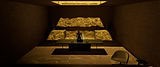
The first image (Fig. 25) is a screenshot from the movie Blade Runner 2049. The second and third images (Fig. 26 and Fig. 27) are my recreations of the same shot in Autodesk Maya. As we can see, the water caustics effect is present throughout the room in this scene, along with multiple motivated light sources coming from different directions.
One primary light source shines down from the ceiling, casting shadows and reflections onto the table. Additionally, one or more other light sources also come from the ceiling, illuminating the wall behind the character. Notably, the chair in the lower right corner is also lit, but not by the primary light source. This is the beauty of motivated lighting—the audience doesn’t question why the chair is illuminated; they simply perceive the scene as visually coherent and natural.
In this scene, all the light sources are constantly changing. As the term "water caustics effect" suggests, the light and shadows are projected onto the walls and floor in a wave-like pattern, resembling water ripples. This differs from traditional 3D lighting techniques. Typically, a lighting artist would set up a fixed primary light source and then add additional supporting lights, such as those used in the three-point lighting technique.

To achieve this effect in Autodesk Maya, I attempted to create multiple area lights from different directions and applied the Gobo effect (Fig. 28) from Arnold Light Filters to some of the area lights that need the water caustics effects. I then assigned the effect to the corresponding area lights and added a sequence of water caustics images to the Slide Map (Fig. 29). This allowed the image sequence to be projected onto the surfaces illuminated by the light sources.
After completing the above steps, I also needed to keyframe parameters such as the exposure and intensity of the area lights at specific frames. This creates the illusion of rippling water on the ceiling (motivated lighting), with the waves dynamically reflecting onto the corresponding surfaces in the scene, fluctuating in brightness. Although there is no actual water in the scene, this motivated lighting technique convinces the audience that there is indeed a pool of water on the ceiling.

The second practice is to recreate a scene with practical lighting in Autodesk Maya based on the reference image from The Matrix.
The first image (Fig. 31) is a screenshot from The Matrix, and the second image (Fig. 32) is my rendered image trying to replicate the lighting and mood of the first image.
I placed area lights on the left side of the screen, behind the windows. I tried to select a warm color similar to the one used in the original movie and combined it with AiAtmosphere in Arnold. Since I am not a texturing expert, I could not replicate the exact texture of the tatami mats from the movie. However, this difference affects the way the bouncing light behaves. In the reference image (Fig. 31), the sunlight streams in at an angle, illuminating the space with a soft, golden glow. This effect creates an immersive ambiance, emphasizing the dojo’s traditional setting.
My 3D-rendered version (Fig. 32) attempts to replicate this but appears more neutral in tone, with less pronounced warmth. The shadows in the render also appear softer and more diffused than in the original, which has sharper, well-defined shadows adding depth and realism. In the reference image (Fig. 31), the tatami mats on the floor and the wooden beams absorb and reflect light naturally, contributing to a realistic environment. My 3D-rendered version (Fig. 32) captures some of this interaction but could benefit from more pronounced global illumination effects, such as subtle light bouncing off the floor and walls to add depth and richness.


